
Portrait photo of Robb Calder

Robb Calder

Astrophysics PhD Student, University of Cambridge

How can we discover what makes a planet habitable, by learning how it can become uninhabitable? My research uses models of planetary interiors and atmospheres to trace how planets evolve toward, or away from, habitable conditions, from abiotic ozone in Venus' atmosphere to sub-Neptunes whose magma oceans never solidify. I am currently developing an end-to-end modelling pipeline to compare my models to observations of sub-Neptune atmospheres. Looking ahead, I want to fold cloud and haze physics into these models, sharpening the tools needed to interpret the next generation of habitability missions.

Research

Magma Oceans on Sub-Neptunes

Can sub-Neptunes, planets larger than Earth but smaller than Neptune, ever be habitable? They're the most common type of planet in the galaxy, but we don't know whether the magma oceans they're born with ever solidify. My recent research has shown that the majority of the sub-Neptunes we've found could remain molten permanently, and never become habitable. Currently, I'm developing a modelling pipeline that can compare models of molten sub-Neptunes with observations, to determine if well-known sub-Neptunes like K2-18 b and TOI-270 d could have magma oceans. Going forward, I want to enhance my models of sub-Neptune evolution by incorporating cloud and haze physics into the pipeline.
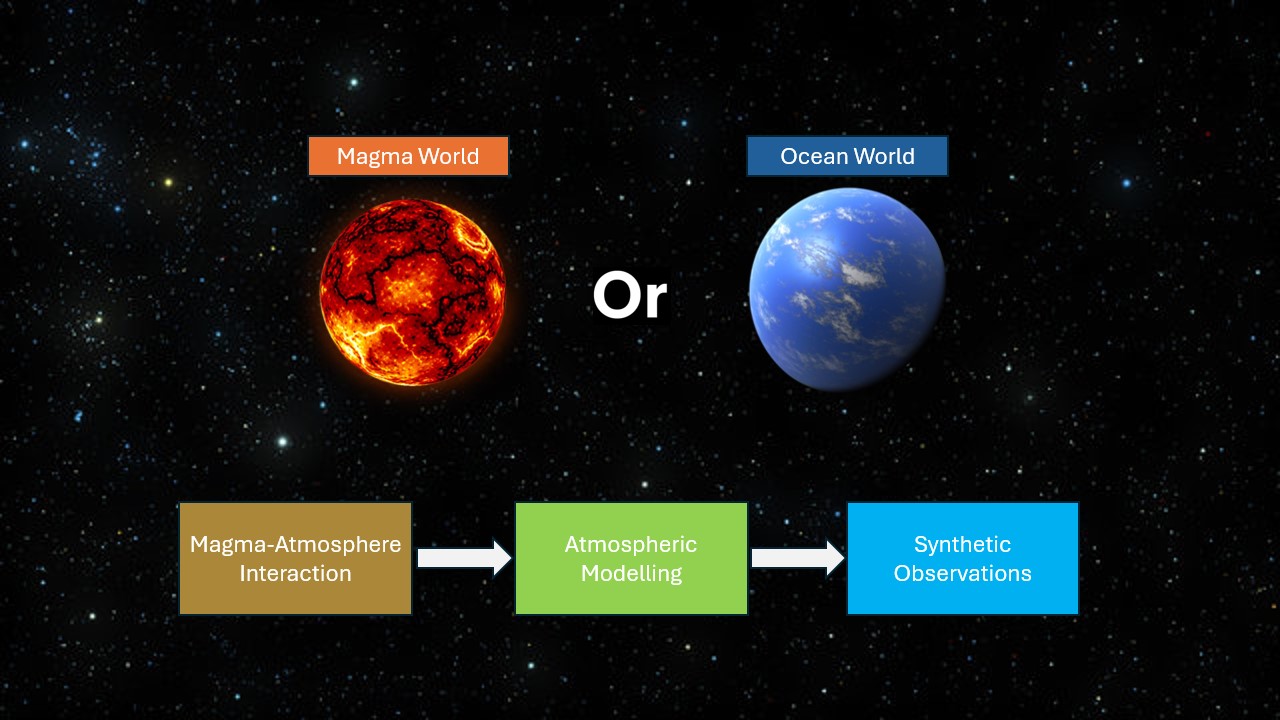
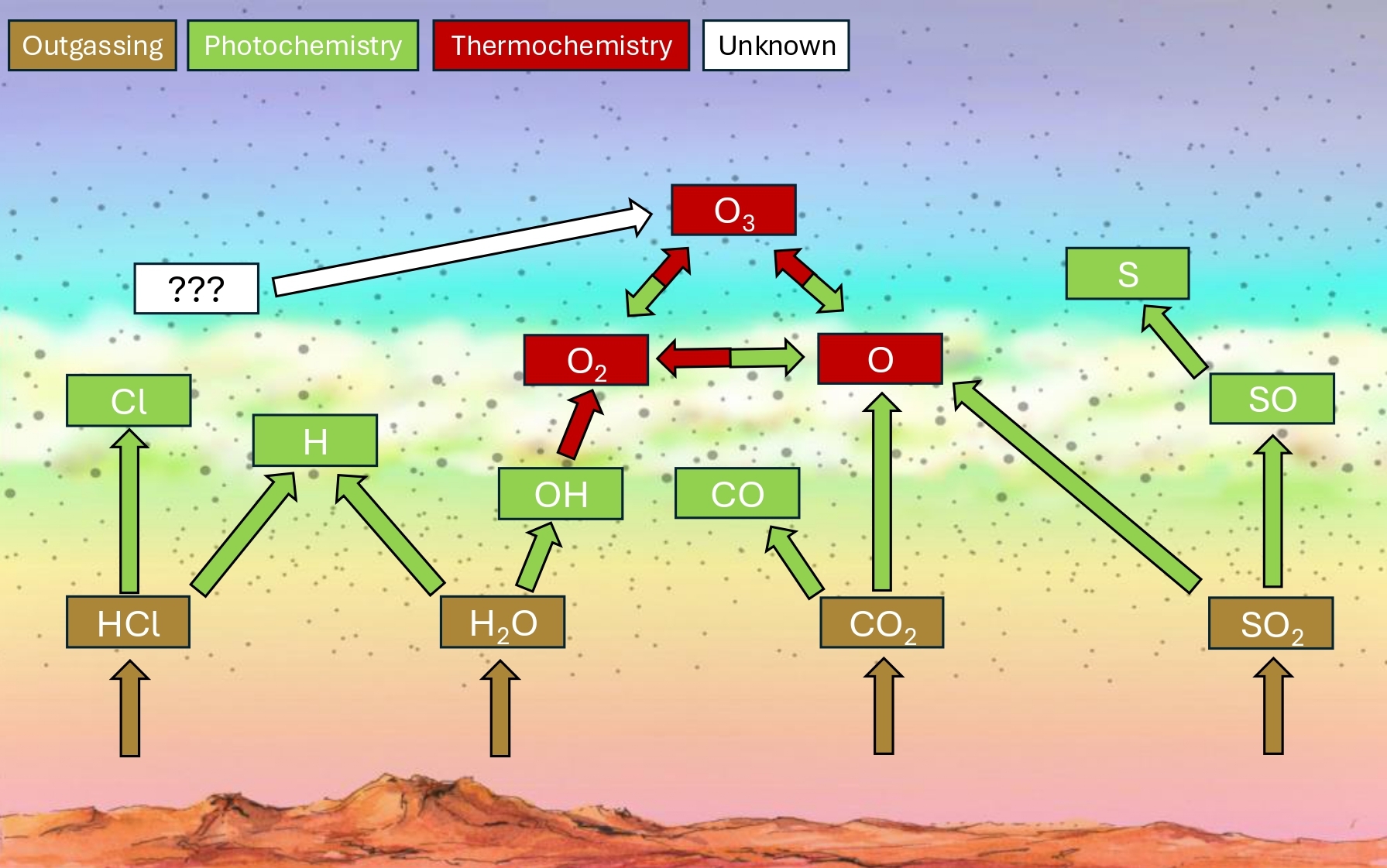
Diagram of magma ocean evolution beneath a hydrogen-dominated atmosphere on a sub-Neptune

Ozone on Venus

Previously, my research focused on ozone in the atmospheres of Venus-like planets. The presence of an ozone layer in Venus' atmosphere is a puzzle, given that atmospheric ozone is considered a strong marker of an inhabited planet. If a similar ozone layer were found on other Venus-like worlds, it could complicate the use of ozone as a marker for identifying habitable Earth-like planets. Using atmospheric models, I found that Venus' observed ozone levels can't be explained by known abiotic chemistry. This motivates further work to find out which pathways are producing the ozone on Venus, and whether these pathways could also act on Venus-like exoplanets.

Diagram of abiotic ozone formation in the atmosphere of Venus

Selected Publications

  • Calder, R., Shorttle, O., Nicholls, H., Lichtenberg, T., & Guimond, C. M. (2026). Most rocky sub-Neptunes are molten: mapping the solidification shoreline for gas dwarf exoplanets. Monthly Notices of the Royal Astronomical Society, 549(3), stag1007. (ADS Link).
  • Calder, R., Shorttle, O., Jordan, S., Rimmer, P., & Constantinou, T. (2025). Abiotic ozone in the observable atmospheres of Venus and Venus-like exoplanets. Monthly Notices of the Royal Astronomical Society, 540(3), 2432-2450. (ADS Link).
  • Helling, C., Samra, D., Lewis, D., Calder, R., Hirst, G., Woitke, P., ... & Chubb, K. L. (2023). Exoplanet weather and climate regimes with clouds and thermal ionospheres-A model grid study in support of large-scale observational campaigns. Astronomy & Astrophysics, 671, A122 (ADS link).

CV

Download CV (PDF)

Your browser can’t display the CV inline. Download it here.

Contact

Address

Institute of Astronomy
Madingley Rd, Cambridge
CB3 0HA

E-mail

rdc49@cam.ac.uk